

Himalayan Monal by Chubzan Tangbi
Tour Dates: Thursday 18th November – Saturday 4th December 2027 (Delhi to Delhi)
Tour Price: £5,299 plus international flight via Delhi
Estimated Flight Price: London to Delhi approx. £700 return. Plus Paro flight approx. £500 Rtn
Deposit: £600 per per person
Conservation Donation from Wise Birding: £150 – £250
Minimum Number: 5 people
Maximum Group Size: 8 people
Target Birds:
Blood Pheasant, Satyr Tragopan, Himalayan Monal, Kalij Pheasant, Snow Pigeon, Black-tailed Crake, Black-necked Crane, Ibisbill, White-bellied Heron, Pallas’s Fish Eagle, Tawny Fish Owl, Himalayan Owl, Ward’s Trogon, Great Hornbill, Rufous-necked Hornbill, Crested Kingfisher, Blue-bearded Bee-eater, Yellow-rumped Honeyguide, Long-tailed Broadbill, Common Green Magpie, Black-rumped Magpie, Broad-billed Warbler, Fire-tailed Myzornis, Golden-breasted Fulvetta, Great Parrotbill, Brown Parrotbill, Grey-headed Parrotbill, White-breasted Parrotbill, Black-throated Parrotbill, Sikkim Wedge-billed Babbler, White-hooded Babbler, Himalayan Cutia, Bhutan Laughingthrush, Red-billed Leiothrix, Spotted Laughingthrush, Beautiful Nuthatch, Wallcreeper, Golden Bush Robin, Little Forktail, Spotted Forktail, Slaty-backed Forktail, Himalayan Bluetail, White-throated Redstart, Mrs. Gould’s Sunbird, Fire-tailed Sunbird, Altai Accentor, White-browed Wagtail, Himalayan Beautiful Rosefinch, Yellow-breasted Greenfinch, Tibetan Siskin.
Target Mammals:
Assamese Macaque, Grey Langur, Capped Langur, Golden Langur, Himalayan Yellow-throated Marten, Sambar, Large-eared Pika and a chance of Red Panda too.
Tour Summary
Bhutan has been protected by both its isolation within the Himalayas and the topography of its mountainous land, resulting in over 70% of the land remaining forested with approximately 25% protected by 10 National Parks and Wild-life Sanctuaries. The diverse range of environments varies from sub-tropical at 150m to alpine over 4,500m, supporting a natural habitat and wide range of eco-systems with rich and varied bird-life, flora and fauna.

Ibisbill by Chubzan Tangbi
Accommodation: 16 nights in Bhutan
1 night Thimpu, 2 nights Punakha, 1 night Phobjikha, 1 night Bumthang, 3 nights Yongkola, 1 night Trongsa, 2 nights Tingtibi, 2 nights Gelephu, 1 night Tsirang, 2 nights Paro.
Inclusive Meals: Full board staring with lunch on day 1 through to breakfast on day 17.

Alpine Thrush by Chubzan Tangbi
Day 1: Arrive in Paro and travel to Thimphu
This morning, we will take the flight from Delhi to Paro where if the visibility is good we will see some spectacular mountain views. Upon arrival, after completing customs and immigration procedures we will embark on a scenic drive along the Pa Chu (river). As we leave what must be one of the most ornate airports in the world, we will search for the Ibisbill, as it dips into the snowmelt in search of food. In this area, we are also likely to spot various bird species, including Wallcreeper, Black-tailed Crake, Olive-backed Pipit, Hodgson’s and Plumbeous Redstart, White Wagtail (most likely of the subspecies alboides), Blue Whistling Thrush, Rufous-breasted Accentor, Rosy Pipit and Russet Sparrows. Once we reach Thimphu, we will visit the Kuensel Phodrang Nature Park, spanning an area of 943 acres. Here, nestled within the ruins of Kuensel Phodrang, we will find the Buddha Dordenma statue. The park is surrounded by forests and offers a stunning view of the Thimphu Valley from the southern approach. It presents excellent opportunities for capturing magnificent panoramic photographs of the valley below. The statue fulfils an ancient prophecy dating back to the 8th century and is believed to radiate an aura of peace and happiness throughout the world. Made of bronze and gilded in gold, it can house seventeen storeys of different Lhakhang and thousands of statues. Standing at a height of 51 meters, it is one of the largest Buddha statues in the world. Overnight Thimphu
Day 2: Birding at Dochu La, Lampelri Park, and continue to Punakha
Today, we will set out early to witness the awe-inspiring sight of the Himalayas as dawn breaks over Dochu La Pass (3150m). The road leading to the pass is adorned with prayer flags and 108 chortens. From the pass there are panoramic views of the Bhutanese Himalayas. Dochu La and Lampelri Park provide the best opportunity to spot the rare and elusive Red Panda, but we will be very fortunate indeed if we find one!
In the high elevations of Bhutan, amidst the mixed evergreen and broad-leaved forests, we will encounter a diverse range of birds and flowering plants. Here, we may have the chance to observe species such as the Hill Partridge, Kalij Pheasant, Large Hawk-cuckoo, Wedge-tailed Green Pigeon, Speckled Wood Pigeon, Rufous-bellied and Darjeeling Woodpeckers, White-collared Blackbird, White-throated Fantail, Brown-flanked and Russet Bush Warblers, Black-winged Cuckooshrike, Chestnut-headed Tesia, Tickell’s and Blyth’s Leaf Warblers, Chestnut-crowned Warbler, Pygmy Cupwing, Black-eared Shrike-babbler, Red-tailed Minla, Brown Parrotbill, Grey-sided Laughingthrush, Rusty-flanked and Hodgson’s Treecreepers, Blue-fronted Redstart, Sapphire Flycatcher and Rufous-bellied Niltava.
Upon arriving in Punakha, we will visit the majestic Punakha Dzong, which was bult in 1637. Perched on a promontory at the confluence of the Mo (mother) and Pho (father) Chu (river), Punakha Dzong is famously known as the “Palace of Great Happiness” and is regarded as one of the most beautiful Dzongs in Bhutan. After visiting the dzong we will bird along the Puna Tshang Chu river valley where we should find Pallas’s Fish Eagle, Bar-headed Goose, Ruddy Shelduck, Red-crested Pochard, Brown Dipper, River Lapwing, Richard’s Pipit, Red-vented Bulbul, Spotted Dove, Scaly-breasted Munia, Slender-billed Oriole and White-browed Wagtail. Overnight Punakha

Red-faced Liocichla by Chubzang Tangbi
Day 3: Birding along Khelekha, Nobding, and Lawa La pass (3350m), and continue to Phobjikha
Today, we will embark on a scenic journey along the winding mountain road, ascending through Oak and Rhododendron forests adorned with lichens, leading us towards Lawa La at an elevation of 3350m. Throughout these diverse habitats, we will have excellent birding opportunities, where we can expect to spot species such as the Ward’s Trogon (one of the top five target species in Bhutan and range restricted to Eastern Himalayas), Spotted Elachura, Rufous-chinned Laughingthrush, Brown-throated Treecreeper, Black-faced Warbler, Chestnut-bellied Rock Thrush, Grey-headed Woodpecker, Dark breasted Rosefinch, Speckled Piculet, Rufous-winged Fulvetta, White-browed Shrike-babbler, Himalayan Cutia, Large Niltava, Rufous-gorgeted and Slaty-blue Flycatchers.
Continuing from Lawa La, our journey will take us to the picturesque Phobjikha Valley, renowned for its Black-necked Cranes. These majestic birds migrate from the Tibetan plateau to over-winter in the valley from late October to March. Phobjikha is one of Bhutan’s few glacial valleys and serves as an important wildlife preserve. We will spend the rest of the day observing the Black-necked Cranes from viewpoints and walking in the valley, as these magnificent birds, another important species to see on birding tours to Bhutan, with their impressive seven and a half foot wingspans gracefully soar overhead. The arrival of these birds is considered an auspicious sign, and the people of the valley eagerly await their annual winter visit, anticipating the blessings they bring. Additionally, the valley is home to a variety of bird species, including the Oriental Skylark, Hen Harrier and Himalayan Vulture. Overnight Phobjikha

Blood Pheasants bt Chubzang Tangbi
Day 4: Birding at Pele La pass (3350m) and continue to Bumthang
As we make our way back through the Lawa La pass at an elevation of 3350m, we pause once again to admire the breathtaking panoramic views before proceeding to our next birding destination at Pele La pass. Some of the target bird species in this area include the Satyr Tragopan, Bearded Vulture, Fire-tailed Myzornis, Dark-rumped Rosefinch, Brown Bullfinch, Verditer Flycatcher, White-winged Grosbeak, Golden-naped Finch, Hume’s Bush Warbler and Rufous-vented Yuhina. Continuing our drive towards Chendibji, we will stop to capture photos of the Nepalese-styled Chorten. Situated alongside the river, this picturesque structure was built in the 19th century by Lama Shida and is modelled after the Sambhunath stupa in Kathmandu, Nepal. According to legend, it was constructed to cover the remains of an evil spirit that was vanquished there. From Chendibji, our journey will lead us through breathtaking landscapes as we make our way to Trongsa. We will then ascend to Yotong La pass, the highest pass of the day at 3450m, before descending into the beautiful Bumthang valley for our overnight stay. Along these routes, we may encounter various bird species, including the Himalayan Buzzard, Short-billed Minivet, Yellow-browed Tit, Grey-sided Bush Warbler, Lemon-rumped Warbler, White-throated Laughingthrush, Green Shrike-babbler, Bar-throated Siva, Rufous Sibia, Red-throated Thrush, White-browed Bush Robin, Green-tailed Sunbird, Alpine Accentor, White-browed Rosefinch and the localised Black-rumped Magpie. Overnight Bumthang
Day 5: Bumthang to Yongkola, birding along Thrumshing La (3780m) and Sengor Valley
This day offers one of the most breathtaking drives in the Himalayas. As we ascend to Selthang La pass at 3600m, weather permitting, we are treated to awe-inspiring views of the magnificent Gangkar Puensum, standing at 7315m, the highest unclimbed peak in the world. Surrounding us are the stunning landscapes of the High Himalayas, adorned with auspicious prayer flags and typical Bhutanese villages. Truly, this is a magical land! Along the way, we will pause and explore the tranquil valley of Ura, the highest of the four valleys in Bumthang. Nestled in the shadow of Thrumshing La (3780m), Ura is a prosperous village. On this section of the journey, we have the opportunity to spot Himalayan Monal, Himalayan Beautiful Rosefinch, Collared Grosbeak, Mrs. Gould’s Sunbird, White-browed Fulvetta, Rufous-vented Tit, Buff-barred Warbler and Black-faced Laughingthrush. Leaving Ura, we continue our ascent through forests of Larch, Silver Fir, Spruce, and towering Hemlocks until we reach Thrumshing La (3780m). Along this magnificent stretch of road, we keep our eyes open for Blood Pheasants feeding by the roadside while enjoying breathtaking views of the Eastern Himalayas. From Thrumshing La, we proceed to the picturesque village of Sengor at 3,000m. In Sengor, we will explore the coniferous forests in search of special bird species, including Bar-winged Wren Babbler, Himalayan Shortwing, Hoary-throated Barwing, Black-headed Shrike-babbler, Fire-tailed Sunbird, Crimson-browed Finch, Himalayan Bluetail, Red-headed Bullfinch and Striated Laughingthrush. At the end of the day, we will drop down to Yongkola, our base for the next three nights. Overnight Yongkola
Day 6 and 7: Exploring the bird-rich Thrumshing La National Park
Thrumshing La National Park is renowned as one of the finest birding destinations in Asia. This captivating landscape provides us with an exceptional opportunity to encounter some of Bhutan’s most extraordinary bird species, many of which are rarely found elsewhere. Alongside numerous commoner species, we will look for another of our main target bird species on the tour – Rufous-necked Hornbill. Bhutan is arguably one of the best places to see this handsome hornbill, but there are plenty more treats in store such as Rufous-throated Wren-babbler, Collared Owlet, Lesser Cuckoo, Grey-cheeked Warbler, Rufous-capped Babbler, Lesser Shortwing, Golden-throated Barbet, Lesser Yellownape, Yellow-cheeked Tit, Nepal House Martin, Grey-bellied and Slaty-bellied Tesias, Mountain Tailorbird, Whistler’s and Broad-billed Warblers, Scaly and Blue-winged Laughingthrushes, Red-faced Liocichla, Yellow-throated Fulvetta, Black-chinned Yuhina, Black-throated and Grey-headed Parrotbills, Alpine Thrush, Golden Bush Robin, Little Forktail, Pygmy Flycatcher, Orange-bellied Leafbird, Scarlet Finch, Rusty-fronted Barwing, Spot-winged Grosbeak, Grey-capped Woodpecker, Grey-chinned Minivet, Grey-backed Shrike, Hair-crested Drongo and Yellow-bellied Fantail. The forests around Yongkola are also a good area to find another of our key birds for the tour. Beautiful Nuthatch can often be found here and we will make a special effort to find this attractive bird during our stay here. As night falls, we will look for Brown Wood Owl, Hodgson’s Frogmouth and Mountain Scops Owl. Overnight Yongkola

Ward’s Trogon by Chubzang Tangbi
Day 8: Yongkola to Trongsa
We will begin our morning by exploring the bird-rich areas of Yongkola. The Sikkim Wedge-billed Babbler haunts the large patches of Bamboo above Yongkola and, although it can be a tricky bird to find, we hope for success this morning. After breakfast, we will proceed towards Bumthang, making several additional stops at Namling, Sengor, and Thrumshing La. During our birding stops, we will be on the lookout for a variety of species, including another most sought-after species – the bizarre looking Slender-billed Scimitar Babbler. Great Parrotbill, Himalayan Monal, Blood Pheasant, Satyr Tragopan, Golden-breasted Fulvetta, Rufous-fronted Tit, Grey-crested Tit, Stripe-throated Yuhina, White-throated Redstart and Streak-breasted Scimitar Babbler will also be on our radar as we gain altitude during the day. In addition to our avian encounters, we might have the opportunity to spot a few mammal species, including the Hoary-bellied Squirrel, Himalayan Five-striped Squirrel, perhaps a Yellow-throated Pine Marten and with a stroke of luck, the rare Red Panda. Overnight Trongsa

Satyr Tragopan, Bhutan by Colin Bushell
Day 9: Trongsa to Tingtibi with birding stops along Shemgang road
Today’s journey will take us through a wide range of altitudes, starting from 2,170m and descending to 600m as we reach Tingtibi. As we drive, we will be treated to magnificent views of the Himalayan landscape. In the morning, our focus will be on spotting various bird species, including Black Eagle, White-tailed Robin, Crested Kingfisher, Barred Cuckoo-dove, Asian Barred Owlet, Crimson-breasted and Bay Woodpeckers, Black-throated Prinia, Long-tailed Shrike, Bhutan Laughingthrush, Spotted Forktail, Grey-headed Canary-flycatcher, White-gorgeted and Little Pied Flycatchers, Bar-winged Flycatcher-shrike, Lesser Racket-tailed Drongo, Black-throated Tit, Striated and Mountain Bulbuls, White-bellied Erpornis, Scaly-breasted Cupwing, Yellow-breasted Greenfinch, Tibetan Serin, Crested Bunting, and Grey-headed Bullfinch.
Following a field breakfast around Kuenga Rubten, we will continue our journey towards Tingtibi, making additional birding stops whenever time permits. Some of the species we can expect to encounter in the area include the Oriental Hobby, Fire-breasted Flowerpecker, Mountain Hawk-eagle, Green-billed Malkoha, Great Hornbill, White-throated Bulbul, Blue Rock Thrush, Common Tailorbird and Yellow-vented Warbler. Overnight Tingtibi
Day 10: Exploring the sub-tropical bamboo forests of Tingtibi (Royal Manas National Park)
Our exploration of the rarely visited Royal Manas National Park in Tingtibi will introduce us to one of the most biodiverse areas in Bhutan, where we can witness an incredible variety of rare and special birds. Throughout the day, our target species will include the critically endangered White-bellied Heron, Pale-billed Parrotbill, White-browed Scimitar Babbler, White-hooded Babbler (a local bamboo specialist), Pin-tailed Green Pigeon, Plaintive, Banded Bay, Drongo and Grey-bellied Cuckoos, White-browed Piculet, Pale-headed Woodpecker (another bamboo specialist), Blyth’s Paradise Flycatcher, Sultan Tit, Yellow-bellied, Yellow-vented and Rufous-faced Warblers, Rusty-cheeked Scimitar Babbler, Rufous-necked and Lesser Necklaced Laughingthrushes, Plain Flowerpecker, Silver-eared Mesia, Blue-winged Siva, Common Hill and Common Mynas, Slaty-backed, Snowy-browed, Dark-sided and Pale Blue Flycatchers, Crimson Sunbird, White-rumped Munia, Grey-throated and Golden Babblers, Striated Yuhina, Blue-capped Rock Thrush, Rufescent Prinia, Plain Martin, Black-crested Bulbul, Tawny Fish Owl, Spot-bellied Eagle Owl, White-throated Needletail and Streaked Spiderhunter.
In addition to the avian wonders, Tingtibi valley presents us with the best chance to observe one of Bhutan’s rare primates, the Golden Langur, as they forage along the roadside.
Overnight Tingtibi
Day 11: Tingtibi to Gelephu, birding along Tama La at 1,661m, Surey and Loderay Valley
We will begin the day by exploring the birdlife around our hotel in Tingtibi, immersing ourselves in the delightful morning chorus. Afterwards, we will set off on our journey towards Tama La, situated at an elevation of 1661m. As we traverse through mixed temperate forests, appreciating the natural beauty of the surroundings, eventually arriving at the picturesque village of Surey. Along the way, we will make a special stop near Tama La, where we have the opportunity to search for the rare Yellow-rumped Honeyguide, a species classified as near-threatened.
Continuing from Surey, we will proceed to the captivating Loderay Valley, where the changing altitudes and vegetation create a haven for a diverse range of bird species. Changeable Hawk-eagle, Rufous-bellied Eagles, Hodgson’s Hawk-cuckoo, Mountain Imperial Pigeon, Blue-bearded Bee-eater, Wreathed Hornbill, Greater Yellownape, White-naped Yuhina, Black-throated Sunbird, Golden-fronted Leafbird, Rufous-backed Sibia, Chestnut-bellied Nuthatch, Maroon Oriole and Coral-billed Scimitar Babbler are all possibilities here. Overnight Gelephu
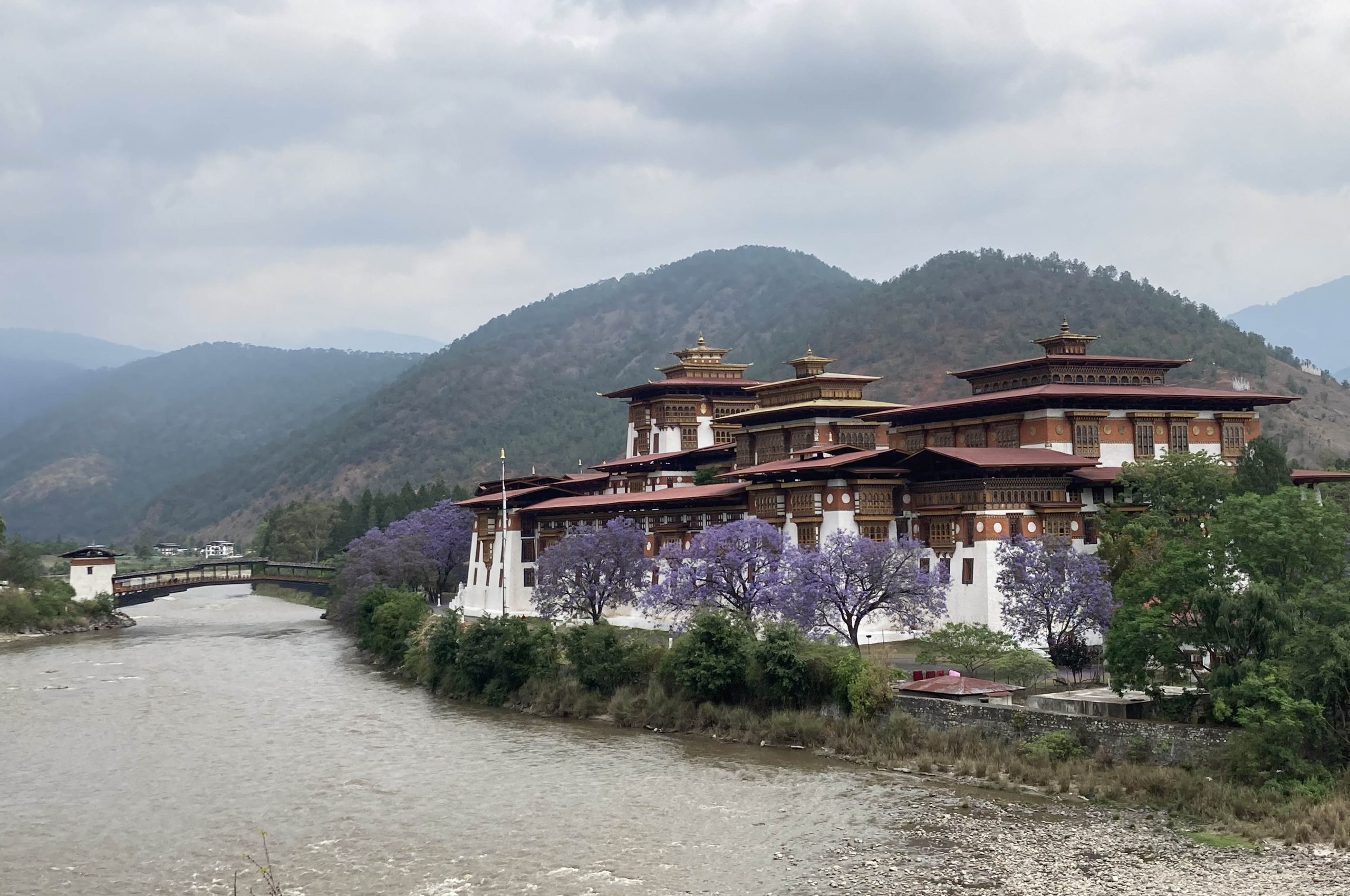
Wonderful Bhutan architecture and scenery by Colin Bushell
Day 12: Exploring the bird rich tropical forests of Gelephu and the water treatment plant
This morning, we will begin our birding adventure in the lush tropical forests of Gelephu, situated at an elevation of 250m. Key bird species include: Alexandrine Parakeet, Jerdon’s Baza, Asian Koel, Rufous Treepie, Greater Coucal, Indian Peafowl, Crested Treeswift, Blue-eared Barbet, Large Woodshrike, Ashy Prinia, Aberrant Bush Warbler, Puff-throated Babbler, Pin-striped Tit Babbler, Great Myna, Asian Pied Starling, White-rumped Shama, Black-hooded Oriole, Common Iora, Indian Thick-knee, Red Collared Dove, Yellow-footed Pigeon, Green Imperial Pigeon, Indian Roller and Sand Lark.
After another field breakfast, our next stop will be the sewage treatment plant, where we can expect to encounter a range of bird species, including Lesser Coucal, Little Cormorant, Pied Kingfisher, Painted Snipe, Lesser Adjutant, Asian Openbill, Red- naped Ibis, Black-naped Monarch, Lineated Barbet, Red-wattled Lapwing, Paddyfield Pipit, Lesser Whistling Duck, Indian Pond Heron, Pied Falconet and White-breasted Waterhen. As night descends, we will embark on a short drive to explore the bustling town of Gelephu in search of owls. Some of the owl species we frequently encounter include Brown Boobook, Collared Scops Owl, Asian Barred Owlet, and Spotted Owlet. Overnight Gelephu
Day 13: Gelephu to Tsirang, birding the areas of Sarpang, Dara Chu, and Tsirang Valley
We will dedicate a significant part of the morning to birding along the Sarpang road. During this excursion, we may encounter a variety of species, including Steppe Eagle, Red Junglefowl, Orange-breasted and Thick-billed Green Pigeons, Emerald Dove, Chestnut-headed and Green Bee-eaters, Oriental Pied Hornbill, Coppersmith Barbet, Greater Racket-tailed Drongo, Jungle Babbler, Jungle Myna, Chestnut-tailed Starling, Pale-chinned Flycatcher, Yellow-vented Flowerpecker, Flycatcher, Asian Fairy-bluebird, Ashy Woodswallow, Green-crowned Warbler, Long- tailed Sibia, Smoky Warbler, Pale-footed Bush Warbler, Dollarbird, Brown Shrike, Fulvous-breasted Woodpecker, Collared Falconet and Abbot’s Babbler. After breakfast, we will continue our birding adventure in the sub-tropical forests above Sarpang, we will enjoy lunch in the scenic surroundings of Dara Chu. In this area, we should find White-crested Laughingthrush, Nepal Fulvetta, Whiskered Yuhina, Long-tailed Broadbill, Red-headed Trogon, Red-billed Leiothrix, and Collared Treepie. Overnight Tsirang
Day 14: Damphu to Punakha – Birding in the Sunkosh Valley
This morning, we embark on a birding journey through the picturesque Sunkosh Valley. Before breakfast, we stop for early birding opportunities, looking for species such as Wedge-tailed Green Pigeon, Striated Yuhina, Crested Goshawk, Crested Serpent Eagle, Black-naped Monarch, and more. After breakfast, we then visit the White-bellied Heron Conservation Centre to learn about this critically endangered species. Continuing our drive along the Sunkosh River Valley, we keep an eye out for the elusive White-bellied Heron – our third opportunity on the trip to spot it. Along the way, we may also encounter other fascinating bird species such as the Greater Goldenback, Blue-throated Barbet, Rufous Woodpecker, Velvet-fronted Nuthatch, Dusky Warbler, Slaty-backed Forktail, Blue-throated Flycatcher and Long-tailed Minivet. Overnight Punakha

White-bellied Heron by Chubzang Tangbi
Day 15: Punakha to Paro – Birding at Menchuna Farm Road and Lamperi Botanical Park
We start early this morning to reach the Menchuna Farm Road for our first birding session of the day. Here, we look for species such as Great Barbet, Striated Bulbul, Russet Bush Warbler, Sapphire Flycatcher, Grey Treepie, Fire-capped Tit, Ashy-throated Warbler, Oriental Honey Buzzard, Himalayan Prinia, Grey-hooded Warbler, and Black-winged Cuckooshrike. After breakfast, we continue to Lamperi Botanical Park and explore its forest trails and Dochula Pass, searching for birds like the Brown Parrotbill, Hill Partridge, Scarlet Finch, Bar-throated Siva, Hoary-throated Barwing and more. In the late afternoon we head for Paro, our base for the next two nights. Overnight Paro
Day 16: Early Morning Birding at Chele La Pass (3,780m), return to Paro
We will depart early in the morning for our journey through ancient Pine and Fir forests to Chele La (3,780m). This location offers fantastic views of the high Himalayan peaks of Jhomolhari (7,219m) and Jichu Drake (6,989m), as well as vistas into the Paro and Ha Valleys. Chele La provides an opportunity to ascend above the tree line into alpine meadows and dwarf Rhododendron scrub. Here, we have the possibility of finding beautiful species such as the Himalayan Monal, Blood and Kalij Pheasants, Black-faced Laughingthrush, Brown Parrotbill, Rufous-bellied Woodpecker, Altai Accentor, White-throated Redstart, Red-throated Thrush and White-collared Blackbird
After lunch, we will continue birding in this beautiful area, checking the mixed species flocks for anything we may have missed thus far, before gradually making our way back to Paro. In Paro, we will stop by the Pa Chhu, looking for the Himalayan riverine species, including the Ibisbill or Black-tailed Crake if we haven’t seen it yet. Overnight Paro
Day 17: Transfer to airport
After breakfast, we will take a short 15-minute drive to Paro Airport and catch our flight with Drukair to Delhi and onward connections.
Please note this is a flexible itinerary which may need to be adjusted slightly dependent on arrival / departure times, weather conditions and the most recent information from our local guides
Leaders: Wise Birding leader plus Chubzang Tangbi
Included in cost: Accommodation in Bhutan in twin-bedded en suite rooms (except at Tingtibi), all meals starting with lunch on day 1 to breakfast on day 17, bottled water, tea/coffee & snacks, ground transport and services of leader.
Also inclusive of Visa and all Sustainable Development Fund (SDF).
Not included in cost: International airfare, travel insurance, any airport fees and drinks other than those listed above.
Single Supplement: £450
Transport: A/C Minibus
Difficulty: Easy asy birding almost exclusively from roads and tracks.
Climate: Generally chilly in the mornings, becoming warmer as the day progresses. Can be cold on high passes with rain (or even sleet and snow) a possibility.
Tour Start Point: Paro Airport, Bhutan
Tour End Point: Paro Airport, Bhutan
Suggested Airlines: London to Delhi British Airways and Bhutan Airlines to Paro

Grey Langur, Bhutan by Colin Bushell