

Turkestan Ground Jay by Machiel Valkenburg
Tour Dates: Monday 1st – Sunday 14th May 2028 (Bukhara to Astana)
Tour Price: £4,499pp plus flights
Estimated International Flight Price: London – Bukhara – Astana – London approx. £1,000 return
Deposit: £600 per per person
Conservation Donation from Wise Birding: £250 – £300
Minimum Number: 8 people
Maximum Group Size: 8 people
Target Birds:
Demoiselle Crane, Ibisbill, Dalmatian Pelican, Sociable Lapwing, White-tailed Lapwing, Caspian Plover, Himalayan Rubythroat, White-throated Robin, Güldenstädt’s Redstart, Yellow-eyed Dove, Pallas’s Sandgrouse, Macqueen’s Bustard, White-winged Woodpecker, White-browed Tit-Warbler, Sulphur-bellied Warbler, Turkestan Ground-Jay, Asian Desert Warbler, Azure Tit, Saxaul Sparrow, Mongolian Finch, Desert Finch, Black-headed Mountain Finch, Blyth’s Rosefinch, Black Lark, White-winged Lark, Grey-necked Bunting, White-capped Bunting and more!
Target Mammals:
Saiga Antelope, Grey Marmot, Steppe Marmot, Grey Wolf, numerous Jerboa species and chances for Marbled Polecat too.

Just some of the stunning scenery to be expected from our route
Tour Summary
This exciting new itinerary takes us into some of Central Asia’s most exciting birding as we visit three incredible countries with a constant backdrop of stunning scenery and fascinating culture and history.
We begin the tour in Uzbekistan where we head to the Kyzyl Kum desert for one of the key species of the tour, the highly sought after Turkestan Ground Jay as well as many other distractions such as Desert Finch and Streaked Scrub Warbler. We then have some exciting days ahead to enjoy some impressive wetland sites and a day up in the mountains where species such as White-throated Robin and Hume’s Lark await us.
Next we take a short flight to Kazakhstan, where we spend just one night before driving across the border into Kyrgyzstan. The mix of stunning birds and incredible mountain scenery here is sure to be a tour highlight as we explore a number of birding sites over the next three days. We will be searching for true avian gems such as Himalayan Rubythroat, White-browed Tit-Warbler, Ibisbill and Himalayan Snowcock. After our time in Kyrgyzstan, we then return by road to Kazakhstan for more fantastic birding and time to experience a couple of nights in our exclusive private Yurt Camp. Birding starts from outside your Yurt where Demoiselle Cranes are often visible along with masses of larks. Nearby we hope to find one of the best looking waders in the world, the exquisite Caspian Plover.
A short flight to Astana is where we spend the final two nights and we visit the fabulous Korgalzhyn National Park where the birding is nothing less than exceptional with so many birds passing through on migration it is a true avian spectacle, as well as being a breeding site for the critically endangered Sociable Lapwing.

Black Lark by Machiel Valkenburg
ACCOMMODATION: 4 nights Uzbekistan, 3 nights Kyrgyzstan and 6 nights Kazakhstan
1 night Bukhara (UZ), 2 nights Smarkand (UZ), 1 night Zaamin (UZ), 1 night Hunting Lodge (KZ), 3 nights Karakol (KYR), 1 night Almaty (KZ), 2 nights Yurt Camp (KZ), 2 nights Astana (KZ)
Inclusive Meals: Full board from lunch on day 1 to breakfast on day 14.
Note: If you wish to arrive a day early and see some of the cultural sites, this can be arranged pre-tour.
Day 1: Bukhara & Kyzyl Kum Desert
Upon arrival at Bukhara Airport, we will be met by our local bird guide and driver and we set off to begin our Central Asian birding adventure!
Our first full day will be devoted to some of the region’s classic desert birds as we head into the Kyzyl Kum desert, where the sparse Saxaul vegetation and open plains provide exciting birding opportunities. Our main target today will be the Turkestan Ground Jay, one of the region’s most sought-after birds, but there will of course be plenty of other avian distractions! Other species we may find in this habitat include Streaked Scrub Robin, Upcher’s Warbler, Menetries’s Warbler, Long-legged Buzzard and Desert Finch. We then return to Bukhara where, if time allows, we can spend a little time exploring some wetland habitat for a good selection of commoner species before returning to Bukhara to enjoy a gentle cultural exploration of this historic Silk Road city. Overnight Bukhara, Uzbekistan
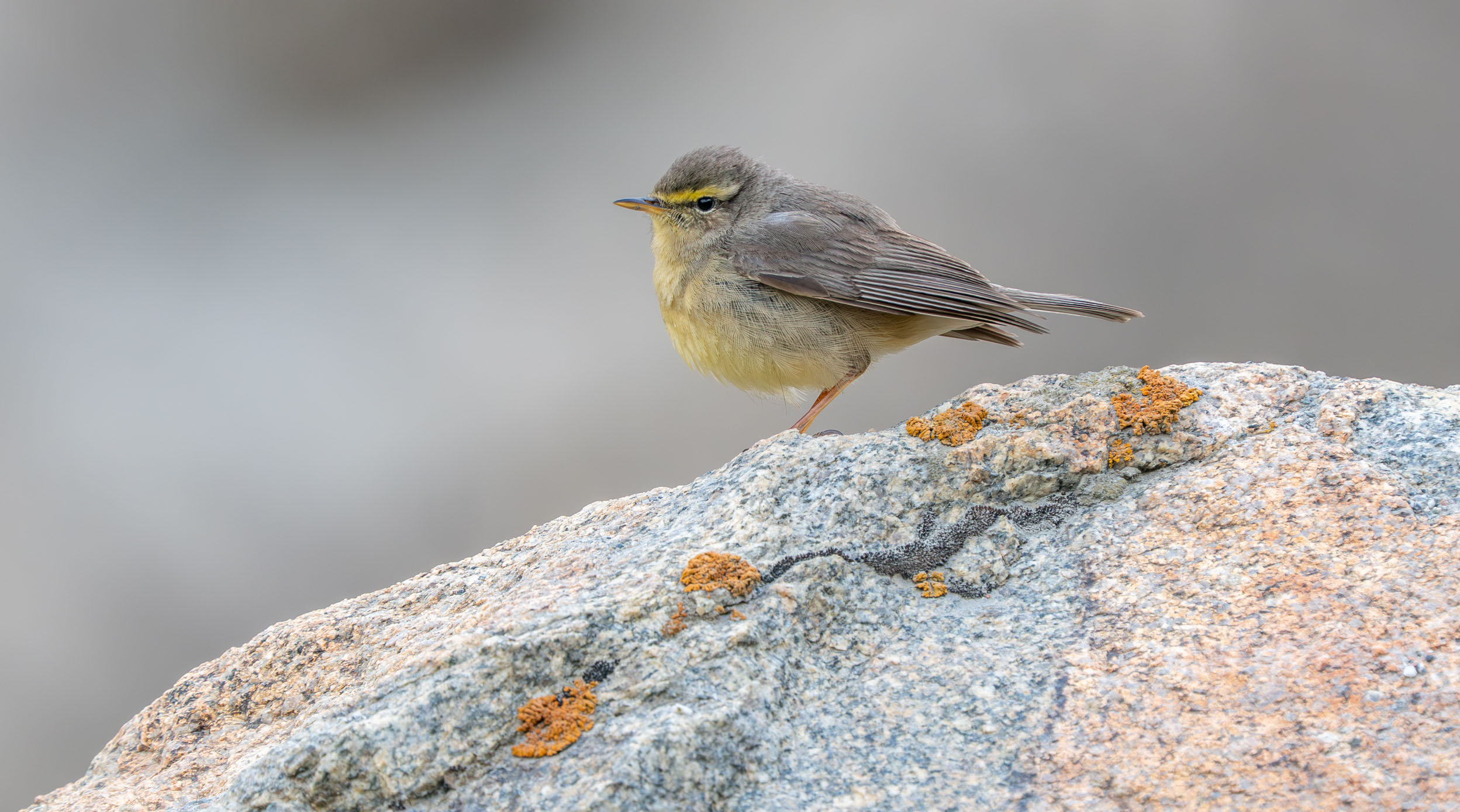
Sulphur-bellied Warbler by Machiel Valkenburg
Day 2: Desert Wetlands & Transfer to Samarkand
We begin the day with an excursion to a series of picturesque desert wetlands south of Bukhara. These lakes and reedbeds, surrounded by an otherwise arid landscape, create surprisingly productive habitats for both migrant and resident birds. Among our targets will be White-tailed Lapwing, Marbled Teal and Blue-cheeked Bee-eater, while a variety of waders and other wetland species should keep us busy.
Returning to Bukhara for lunch, we then embark on the five-hour journey to Samarkand. Along the way, there will be opportunities to stop and bird suitable habitats where we hope to find species such as the Pied Bushchat, Azure Tit and Pied Wheatear. Overnight Samarkand, Uzbekistan
Day 3: Takhtakaracha Pass & Samarkand
Today we climb towards the Takhtakaracha Pass, where the landscape changes dramatically to rugged mountain terrain. Key target species today include White-throated Robin, Wallcreeper and maybe Hume’s Lark too while raptors such as Bearded Vulture and Golden Eagle glide overhead.
After our full morning in the mountains, we return to Samarkand for the late afternoon and if there is time and enough interest, we may visit some of the key monuments and experience the atmosphere of this remarkable historic Silk Road city centre.
Overnight Samarkand, Uzbekistan

Caspian Plover by Machiel Valkenburg

Sociable Lapwing by Machiel Valkenburg
Day 4: Samarkand to Zaamin
Today we travel eastwards from Samarkand towards Zaamin, with the landscape gradually changing as we approach the foothills of the Tian Shan mountains where our main focus will be the striking Blyth’s Rosefinch. However, we will also be making many birding stops en route for species such as the yellow-breasted form of Azure Tit, White-browed Tit-Warbler and Hume’s Whitethroat. Overnight Zaamin, Uzbekistan
Day 5: Samarkand to Almaty, Kazakhstan
This morning we transfer to the airport for our flight to Kazakhstan and the city of Almaty.
Set against the spectacular backdrop of the snow-capped Tien Shan mountains, Almaty is renowned as one of Central Asia’s greenest cities. Tree-lined avenues, expansive parks and lush gardens give the city a remarkably fresh and relaxed feel. Apple orchards, for which the region is famous, surround the city, and clear mountain streams flow down from the nearby peaks.
On arrival in Almaty we head east to our lodge in the Charyn Canyon region and if there is still time, we will visit a water well where both Mongolian Finch and Grey-necked Bunting come to drink. Overnight Hunting Lodge, Kazakhstan

White-tailed Rubythroat by Machiel Valkenburg
Day 6: Charyn Canyon & into Kyrgyzstan
We will visit the Sogety Valley and Charyn Canyon region during the morning. A vast and wild landscape of semi-desert, Steppe, and dramatic rock formations. This area offers excellent birding opportunities, with a focus on species such as Pallas’s Sandgrouse, White-capped Bunting, Grey-necked Bunting and Asian Desert Warbler, all well adapted to these arid environments. Other birds we will be looking for include Syke’s Warbler, Red-headed Bunting, Desert, Mongolian and Crimson-winged Finches.
The spectacular Charyn Canyon, often referred to as the “Grand Canyon of Central Asia” was carved over millions of years by the Charyn River, the canyon features towering red sandstone cliffs, deep gorges, and surreal rock formations. In the afternoon we cross into Kyrgyzstan and drive to the city of Karakol where we stay in a lovely guesthouse. Overnight Karakol, Kyrgyzstan
Days 7 & 8: Altai Mountains of Kyrgyzstan
Over the next couple of days, we will explore a variety of habitats, from alpine meadows and spruce forests to rocky slopes and fast-flowing mountain rivers. Our main targets include true Himalayan gems such as the stunning Himalayan Rubythroat, White-browed Tit-Warbler, Sulphur-bellied Warbler, and the impressive Himalayan Snowcock. The high mountains also give us excellent chances for specialties like Black-throated Accentor and Brown Accentor, often found in more rugged terrain. Along clear mountain streams, we will also search for the highly prized Ibisbill! Overhead, large raptors patrol the valleys and ridgelines, with good chances of encountering the majestic Bearded Vulture, alongside Golden Eagles and Himalayan Griffon Vultures.
In the agricultural fields and wetlands surrounding Karakol, birding is equally rewarding, with species such as Oriental Turtle-Dove, and Pallas’s Grasshopper Warbler. The combination of dramatic landscape, varied habitats, and a superb selection of mountain and Steppe birds, Kyrgyzstan promises to be a memorable part of the tour. Overnight Karakol, Kyrgyzstan

Blyth’s Rosefinch by Machiel Valkenburg
Day 9: Returning to Almaty & Southern Kazakhstan
We retrace our steps today, returning to Almaty as we cross back into Kazakhstan. After completing border formalities, we re-enter the vast open landscapes of southeastern Kazakhstan. We will revisit the Sogety Valley, giving us another opportunity to connect with any species we may have missed earlier, such as Pallas’s Sandgrouse, Grey-necked Bunting, or Mongolian Finch. Time and conditions permitting, we will also explore Kokpek Pass, a productive area where Steppe and semi-desert habitats meet, often yielding more chances for the specialties and raptors. Overnight Almaty, Kazakhstan
Day 10: Into the Taukum Desert
Our Taukum Desert adventure begins with an early departure from Almaty as we head west into the vast open landscapes of the Steppe and desert. Our first stop is at Sorbulak Lake, an important wetland site. Here, we have good chances for Terek Sandpiper as well as hugely impressive numbers of waterfowl. With luck, we may find both Great White Pelican and Dalmatian Pelican. Continuing into the Taukum Desert, we will spend time birding the Artesian wells. This can be an exceptional location during migration, where birds concentrate in huge numbers in an otherwise dry landscape. The area can be alive with larks, including Asian Short-toed Lark, Greater Short-toed Lark, Calandra Lark, Bimaculated Lark, and Crested Lark, often in hugely impressive flocks. We stay overnight at our exclusive Yurt Camp, located in a quiet and scenic part of the desert. Our camp offers a very comfortable experience, with well-maintained traditional yurts, proper beds, and good toilet facilities.
In the evening, after dinner, we head out for a night excursion in search of Jerboas and other nocturnal mammals such as Steppe and/or Marbled Polecat. Overnight Yurt Camp, Kazakhstan

White-winged Lark by Machiel Valkenburg
Day 11: Taukum Desert – Topar Lake – Zheltorangly Forest
We will further explore the famous Taukum Desert, with special focus on the high quality species, including Macqueen’s Bustard and stunning Caspian Plover. The latter is one of Central Asia’s most elegant and localised breeding birds, preferring remote, undisturbed Steppe habitat. Observing this species in its natural habitat, often displaying on open plains, is a real highlight for any birder. The vast desert landscape, with its sandy expanses and scattered saxaul vegetation, provides ideal conditions for these iconic species, along with a variety of other desert-adapted birds and mammals too such as Saiga Antelope.
In the afternoon, we visit Topar Lake and the unique Zheltorangly Forest, a rare patch of Saxaul woodland that offers a completely different habitat. Here, we search for Central Asian specialties such as Saxaul Sparrow, Yellow-eyed Dove, Shikra, and White-winged Woodpecker, often in a peaceful and lightly wooded environment that contrasts beautifully with the open desert. Overnight Yurt Camp

Saiga Antelope by Machiel Valkenburg
Day 12: Taukum Desert – Almaty – Astana
We spend our final morning birding in the Taukum Desert, focusing on any species we may have missed during the previous days. This gives us a last opportunity to connect with key desert specialties
such as Macqueen’s Bustard, Caspian Plover, or the various lark species that characterise this unique habitat. After a relaxed breakfast at camp, we begin our journey back to Almaty, once again passing by Sorbulak Lake. Depending on time and conditions, we may make a short stop here to check for any additional waterbirds or waders.
By late afternoon, we arrive back in Almaty, where we say goodbye to our driver for the Almaty region and board our flight to Astana. Overnight Astana, Kazakhstan
Day 13: Korgalzhyn National Park & Tengiz Lake
We will start our day very early, heading out to the Korgalzhyn National Park. This vast wetland area, which combines virgin Steppe and lakes, is home to Wolves, Marmots, and Saiga Antelope, the latter of which have become increasingly easier to find in recent years. However, it is the birds that are the real attraction. Situated at the crossroads of two migration routes, these wetlands act as a giant motorway junction service station for birds. Lake Tengiz alone has the capacity to feed 15 million birds! Our main targets here are nesting groups of the critically endangered Sociable Lapwing, but there is so much more for us to enjoy in this vast landscape. Roadside colonies of Black-winged Pratincoles and White-winged Black Terns in glorious breeding plumage should be dotted with migrant shorebirds such as Red-necked Phalaropes, Spotted Redshank, Terek Sandpiper, Ruffs displaying in all their finery, as well as Little and Temminck’s Stints. The wetlands and lakes should also produce breeding Dalmatian Pelicans, Great Bitterns, White-headed Ducks, Red-necked and Black-necked Grebes, Whooper Swans, Graylag Geese, Red-crested Pochards, and Caspian Terns. More special still are the often close colonies of splendid Great Black-headed Gulls, with a supporting cast of Steppe and Slender-billed Gulls. The damp, grassy steppe contains elegant Demoiselle Cranes, while scattered scrub bushes should hold Booted Warblers, Pallid Harriers, and gorgeous Red-footed Falcons. Two other very special birds we should find today are Black Lark and White-winged Lark, both are often numerous along the roadside and are confined to the Central Asian Steppes. In the evening, we will return to our hotel in Astana where we enjoy a final celebratory dinner in an authentic local restaurant. Overnight Astana, Kazakhstan
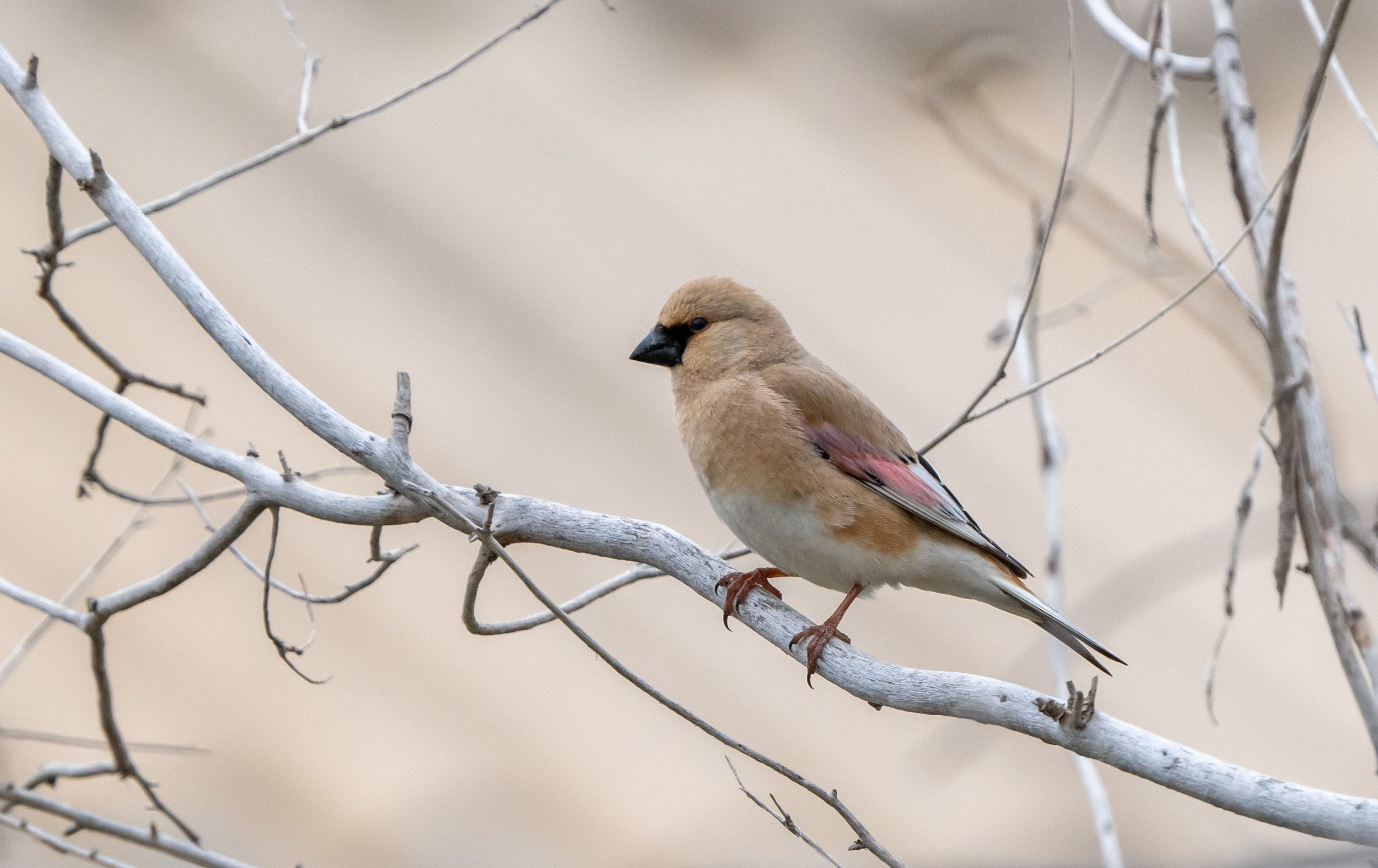
Desert Finch by Machiel Valkenburg
Day 14: Departure
Our final morning is arranged around our flight schedule, allowing time for a final breakfast and any last-minute birding or relaxation before transferring to Astana International Airport where the tour ends.
Important: This is a flexible itinerary which may need to be adjusted slightly dependent on arrival / departure times, weather conditions and the most recent information from our local guides
Leaders: Wise Birding leader and local guides throughout
Included in cost: Accommodation in twin rooms, including 2 nights in comfortable Yurt. All meals, bottled water, all entrance fees to reserves and national parks, ground transport and services of leaders.
Not included in cost: International airfare to/from Kazakhstan, travel insurance, drinks other than water and any airport/visa fees.
Single Supplement: £499
Transport: Air-conditioned minibus throughout.
Difficulty: Easy to moderate. Most birding will be on flat tracks close to our vehicle, but there will be times when we are in the mountains, sometimes over 2,000 metres, where we will be walking fairly steep undulating trails. We will walk no more than around 2-3 miles per day on average.
Climate: A mix of cold (near freezing early in the mountains) to pleasantly warm at middle altitudes and then really quite hot when in the Steppe and lowland areas of Kazakhstan and Uzbekistan.
Tour Start Point: Bukhara, Uzbekistan
Tour End Point: Astana, Kazakhstan
Suggested Airlines: Air Astana from London direct to Bukhara.

Pallas’s Sandgrouse by Machiel Valkenburg